

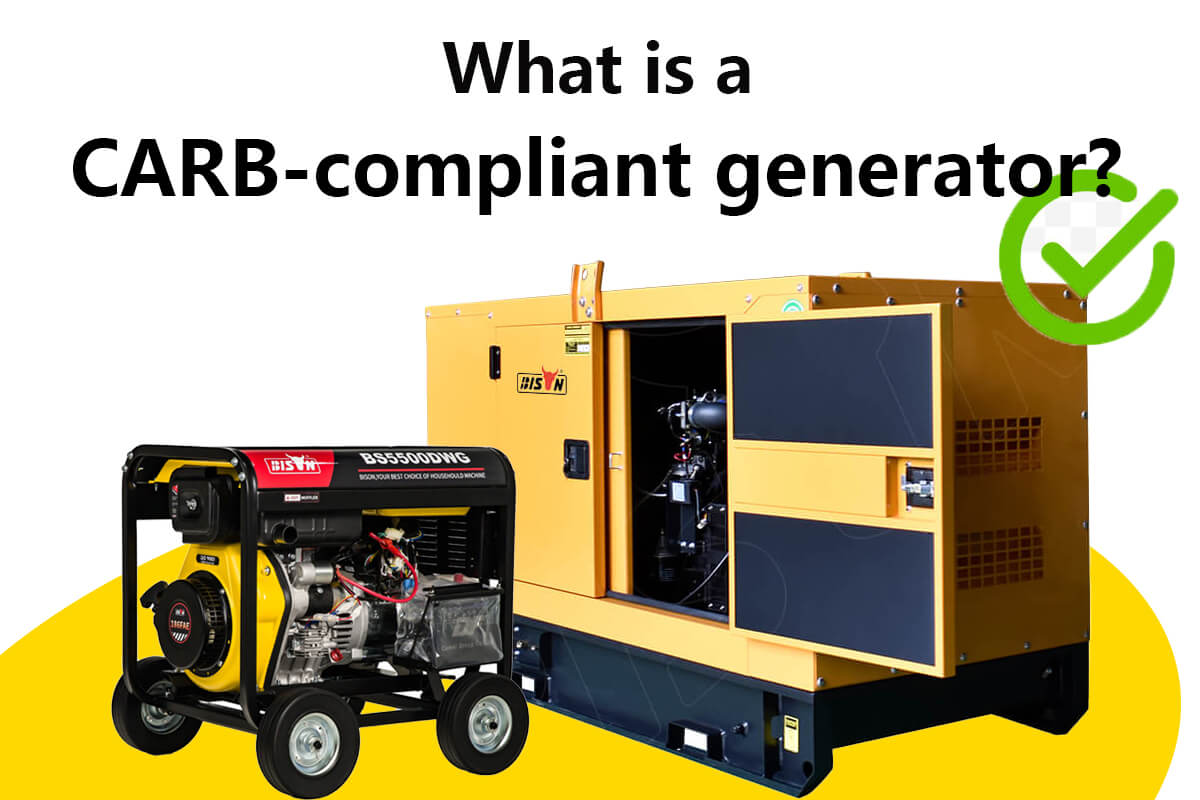
What is a CARB-compliant generator?
- BY BISON
Table of Contents
The relationship between the fresh air we breathe and the type of generator we choose may not be obvious, but the two are inextricably linked. A CARB-compliant generator is a generator that meets stricter environmental standards for power generation equipment set by the California Air Resources Board. This standard requires power generation equipment to reduce harmful emissions, toxins, and particulate matter to ensure cleaner, safer air quality. As a result, CARB-compliant generators use advanced technology, operate more efficiently, and significantly reduce greenhouse gas emissions.
You may also be confused by the term “CARB compliant” in your generator owner’s manual. Well, follow BISON now to learn what CARB-compliant generators are, and their role and importance in reducing air pollution and achieving a sustainable future.
What is CARB?
The acronym CARB refers to the California Air Resources Board, a state agency established in 1967 that enforces air quality standards stricter than the federal Clean Air Act, which was enacted that same year. However, the state of California’s commitment to tackling pollutants and promoting clean air dates back to as early as the 1940s with the inception of the Los Angeles County Air Pollution District. Today, CARB has grown into a pioneering force in environmental protection, with comprehensive air quality regulations covering all major sources of air pollution, including smog-forming compounds and greenhouse gases.
What is a CARB-compliant generator?
The California Air Resources Board (CARB) enforces air quality standards for generators and related equipment. To accomplish this, CARB establishes up-to-date emission standards that generators are required to meet. Generators that meet these standards are labeled as CARB Compliant, whereas those that don’t are referred to as CARB Noncompliant.
The certification process for this type of generator involves rigorous testing and verification procedures. The certification process includes detailed documentation of equipment specifications, comprehensive emissions test data, and verification of the effectiveness of the emission control system. In addition, manufacturers must also provide clear labels on their equipment to indicate that they comply with CARB standards so that consumers and regulators can easily identify certified products.
What is the difference between CARB-compliant and CARB-non-compliant?
Adherence to CARB standards indicates that your equipment complies with the current emission guidelines set forth by CARB. Equipment that is CARB-compliant emits fewer harmful substances, toxins, and particles, leading to improved and safer air quality.
CARB strives to control the emission of:
- Carbon monoxide (CO).
- Carbon dioxide (CO2).
- Nitric oxides (NOx).
- Hydrocarbons (HC).
- Particulate matter (PM).
To this end, when BISON produces generators, the detailed design and production processes will be upgraded. In addition, CARB-compliant generators are noted on the label for easy identification. For mandatory compliance requirements in California and other states that follow CARB standards, when purchasing equipment, you can consult the BISON generator supplier to learn about CARB-compliant options.

Why choose a CARB-compliant generator?
Choosing a CARB-compliant generator is crucial for companies and institutions functioning in California, as it guarantees adherence to state regulations and diminishes the environmental impact of their activities. By grasping and abiding by CARB’s emission standards, companies and institutions can legally use their generators and contribute to enhancing California’s air quality.
Primarily, adhering to the emission standards set by the California Air Resources Board (CARB) is a legal necessity when using a generator in California. Failure to comply with these regulations may lead to fines and penalties.
Moreover, a generator that meets CARB standards aids in lessening the environmental and public health consequences of generator usage by lowering emissions of pollutants such as particulate matter, nitrogen oxides, and hydrocarbons. This results in improved local air quality and supports the overall health and well-being of the community.
Lastly, by choosing a CARB-compliant generator, businesses and organizations can avoid the costs and penalties associated with non-compliance while also saving on fuel and maintenance in the long run. This is because CARB-compliant generators are designed to function more efficiently, leading to decreased operating expenses.
Why Is CARB compliance important?
Generators that fail to meet CARB standards emit harmful pollutants that can degrade air quality and reduce the quality of life. By adhering to CARB regulations, not only is the air quality kept at healthier levels, but several other advantages are also offered. Firstly, a generator or engine that complies with CARB regulations exhibits superior efficiency and reliability. The benefits of CARB-compliant generators extend beyond these aspects:
- Quality and durability: CARB-compliant generators are manufactured to meet rigorous standards, resulting in improved fuel economy and reliable operation.
- Reduced air pollution: By using a CARB-compliant generator during power outages, you’re ensuring that your health isn’t compromised due to polluted air. Gas-powered generator pollutants such as particulate matter and nitrogen oxides can worsen respiratory conditions like asthma, particularly in urban areas.
- Avoidance of penalties: Purchasing or selling a noncompliant generator could result in fines, according to local or state laws. CARB-compliant generators meet stricter standards than those set by the Environmental Protection Agency regulations, thereby reducing the risk of incurring fines.
- Eco-friendliness: From the outset, CARB’s primary objective has been to minimize the environmental footprint of engine emissions. Selecting a CARB-compliant generator contributes to the conservation of our planet.
- Well-being: Generators that comply with CARB regulations emit fewer harmful substances, ensuring safer usage. You can confidently use your generator, knowing it adheres to stringent regulations and produces the minimum possible harmful emissions.
- Regulatory adherence: Given that CARB enforces the most rigorous emission standards in the nation, you can trust that your CARB-compliant generator satisfies all necessary criteria, regardless of your business location.

Benefits of a CARB-compliant generator
As a solution, CARB regulations permit the use of backup generators to compensate for grid power loss. However, these generators, which run on combustible fuels with high greenhouse gas emissions, can deteriorate air quality and pose risks to public health.
Generators that comply with CARB regulations tackle all these issues simultaneously, offering environmental, health, and financial gains. Even outside of California, choosing a CARB-compliant generator carries several benefits:
- Extended, cleaner power supply — CARB-compliant generators are typically 5–10% more fuel-efficient due to optimized combustion and electronic fuel management.
- Reduced environmental pollution — Users don’t have to compromise their surroundings if they require backup power during a power outage.
- Minimized health hazards — Generators that run cleaner pose less threat to individuals with respiratory or cardiac issues, avoiding the sulfuric oxide and carbon monoxide exposure tied to noncompliant units.
- No sanction risks — The sale or acquisition of a generator that does not meet CARB requirements may result in fines, depending on state, territory, or local regulations.
- Superior machinery parts — Components for CARB-compliant generators are designed for optimal fuel efficiency, reliability, and the cleanest possible operation.
How do you choose a CARB-compliant generator?
Choosing a CARB-compliant generator involves focusing on several crucial aspects, so companies and organizations can make a well-informed choice.
- Confirm compliance: The initial step in selecting a CARB-compliant generator is ensuring that it adheres to the emission regulations established by the California Air Resources Board (CARB). Keep an eye out for a CARB compliance label or certificate on the generator or provided by the manufacturer.
- Appropriate size: Accurately determining the generator’s size for the load it will handle is vital for optimal efficiency and emission reduction.
- Emission rating: CARB enforces limits on the pollutants a generator can produce. Aim for the minimum emission rating to minimize the environmental impact of generator usage.
- Fuel variety: Emission ratings vary with different fuel types. Opt for a fuel with a lower emission rating, like natural gas or propane.
- Maintenance and support: Routine maintenance and servicing are essential for a generator to consistently meet CARB emission standards. Select a generator with accessible maintenance procedures and ensure adequate manufacturer support is available.
- Manufacturer credibility: You should choose a brand with a strong reputation for providing high-quality, reliable, and CARB-compliant generators (such as BISON generator suppliers).
By weighing these factors, companies and organizations can select a CARB-compliant generator that fulfills their requirements and enables them to operate legally and efficiently in California.

What is the difference between CARB and EPA?
CARB is a Californian agency that oversees the regulation of emissions from generators and engines solely within California. The Environmental Protection Agency (EPA), a federal agency, administers laws related to emissions across the country. The key distinction between CARB and EPA lies in CARB’s significantly more stringent standards.
Engines and generators that comply with CARB regulations are more efficient and effective. While every engine in the United States must meet EPA standards, Only California legally requires CARB compliance, but more than a dozen states (16+) have adopted CARB standards under Clean Air Act Section 177 — so compliance matters well beyond California.
Difference between CARB and EPA TIERS I, II, III, and IV
The EPA’s monitoring of generator emissions diverges from CARB regulations in terms of tier rules. While they have different requirements, both sets of regulations aim to reduce fuel emissions through their unique rules and guidelines. Diesel generators fall under the purview of EPA Tiers for equipment powered by nonroad diesel engines.
While EPA Tiers mainly pertain to diesel engines, including diesel generators, there are also natural gas generators manufactured that comply with EPA certifications, known as EPA Certified natural gas generator sets. The EPA Tiers demonstrate how alterations to engines over time have enhanced their eco-friendliness. Generator emissions should meet the strictest EPA Tier standards in place at the time of production.
- Tier 1: The EPA adopted its first nonroad diesel emissions standard, Tier 1, in 1994 for engines rated at or above 37 kilowatts.
- Tier 2: Adopted in 2001, Tier 2 marked the initial phase in the goal to slash nonroad diesel engine emissions by up to two-thirds compared to Tier 1, implementing more rigorous standards than its predecessor.
- Tier 3: Introduced in 2006, Tier 3 represented the next step in reducing emissions for nonroad diesel engines, gradually replacing Tier 2.
- Tier 4: Tier 4 (phased in from 2008, with final standards applying through 2014–2015 by power rating) established the strictest testing and operation standards for nonroad diesel engines. Tier 4 cuts NOx by ~90% and PM by ~90% compared to Tier 1.
Conclusion
Complying with CARB regulations is a legal requirement in California and increasingly in other states that adopt CARB standards. CARB regulations help reduce air pollutants, which protects oxygen production in trees and even prevents global warming by protecting ice caps.
The primary distinction between CARB-compliant and non-compliant equipment lies in their environmental impact. Specifically, CARB-compliant machines contribute to cleaner and safer air quality due to their lower emission levels.
To ensure you contribute to a healthier environment, consider choosing a CARB-compliant BISON generator.
FAQs
What are the roles of the California Air Resources Board?
CARB’s primary goal is to maintain clean air and lower pollution rates by implementing rigorous rules and policies. It undertakes comprehensive measures across the state to safeguard Californians from the harmful effects of air pollutants and toxins, achieved through the development of strict emissions guidelines.
How does CARB affect generators?
Power generation equipment, particularly commercial and industrial generators, are unable to entirely eradicate their emissions and particulates. The objective of CARB is to implement fuel restrictions to minimize these generator emissions. Generators that comply with CARB regulations emit less harmful substances and particulates into the environment, leading to improved and safer air quality.
Even if your operations are located outside California, your state may enforce CARB standards. CARB-compliant generators are legal to use in any US state, while non-compliant models may be restricted in states enforcing CARB rules.
How do I verify a generator is CARB-compliant?
Look for the CARB compliance label or Executive Order number on the unit or in the manual; verify against CARB's official database.
contact us
related product categories
Get in touch to speak with our experts!
Related articles

How inverter generator works?

how to make portable generator power clean

How to choose the generator fuel type?
